10/12/2025
Hector Chan
Asia Art Center (Beijing), until 2026.02.08
“As a Chinese artist, one may well be a global individual, transcending national identity; creating works that appear distinctly ‘Western’ is perfectly legitimate. Likewise, one may remain profoundly ‘Chinese,’ allowing one’s cultural inheritance to flow freely and without self-consciousness. What I object to is the deliberate instrumentalization of globalization or nationalism for the sake of effect—such gestures, in the end, risk collapsing into superficial posturing.”
—Wang Jieyin
It is a rare statement of clarity from an artist of Wang Jieyin’s generation, and an apt point of departure for his new exhibition at Asia Art Center. In a moment when cultural positioning often functions as branding—declared, performed, sometimes over-performed—Wang’s refusal to weaponize identity feels both principled and quietly radical. His paintings neither announce their “Chineseness” nor disguise their cosmopolitan affinities. Instead, they inhabit a niche entirely his own: an art in which influence registers not as citation, but as sediment.
山色之二 Scenery of Mountains, No. 2
140×350cm
纸本综合材料 Mixed Media on Paper
2023
Courtesy of the Gallery
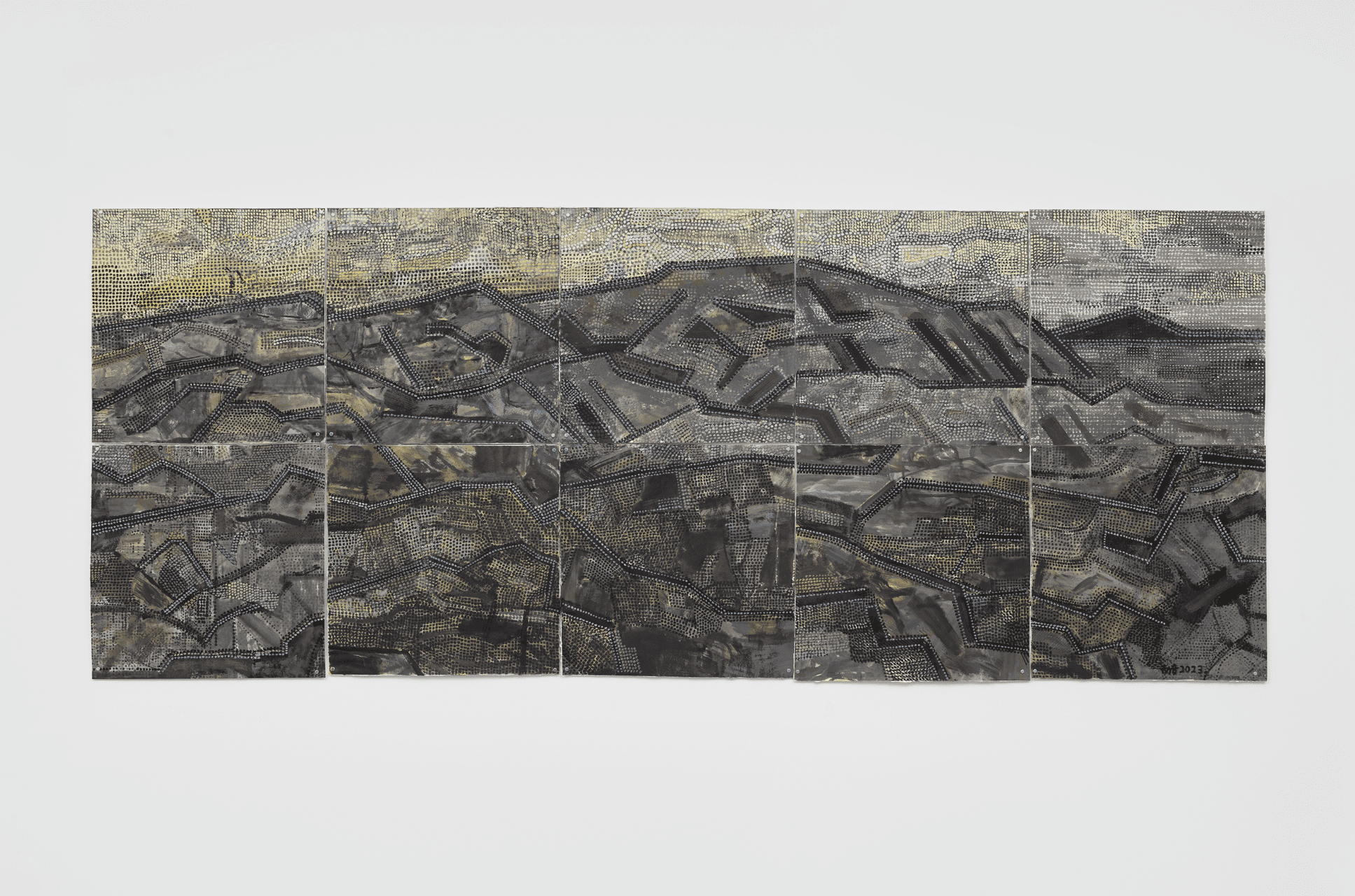
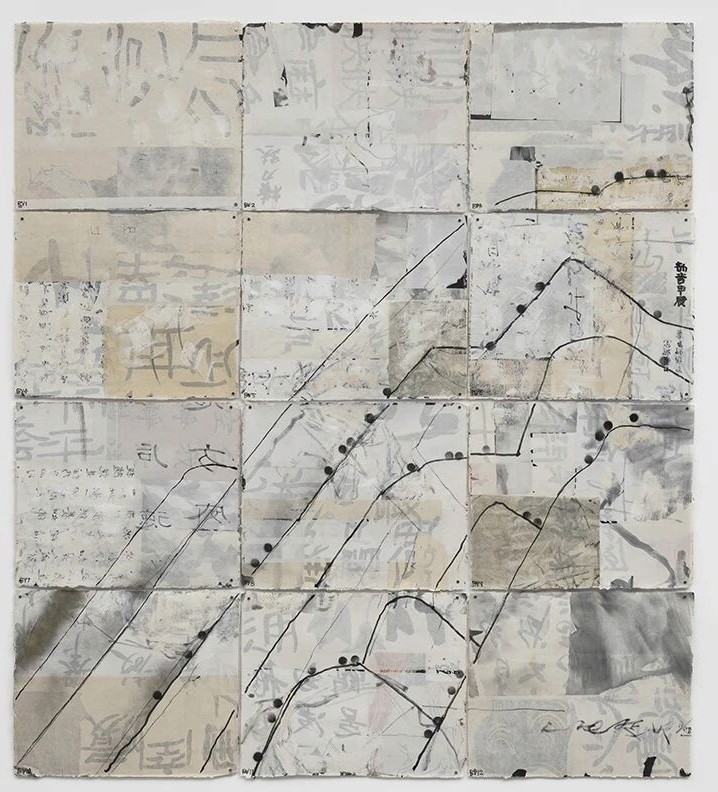
The exhibition opens with a series of large-scale composites built from layered paper panels. From a distance, the surfaces form misted landscapes—slopes, ridges, or barely-there horizons. Up close, these dissolve into vibrating matrices of dots and strokes. Western precedents inevitably come to mind: the chromatic tremors of pointillism, the earthy tactility of Dubuffet’s postwar terrains. Yet the techniques themselves remain unmistakably Asian. The beauty of ink is everywhere—the feathered edges, the tonal breaths, the slight unpredictability of fiber absorbing water. Even in works rendered chiefly in acrylic, Wang preserves this ink-born sensitivity; acrylic becomes translucent, porous, almost meditative.
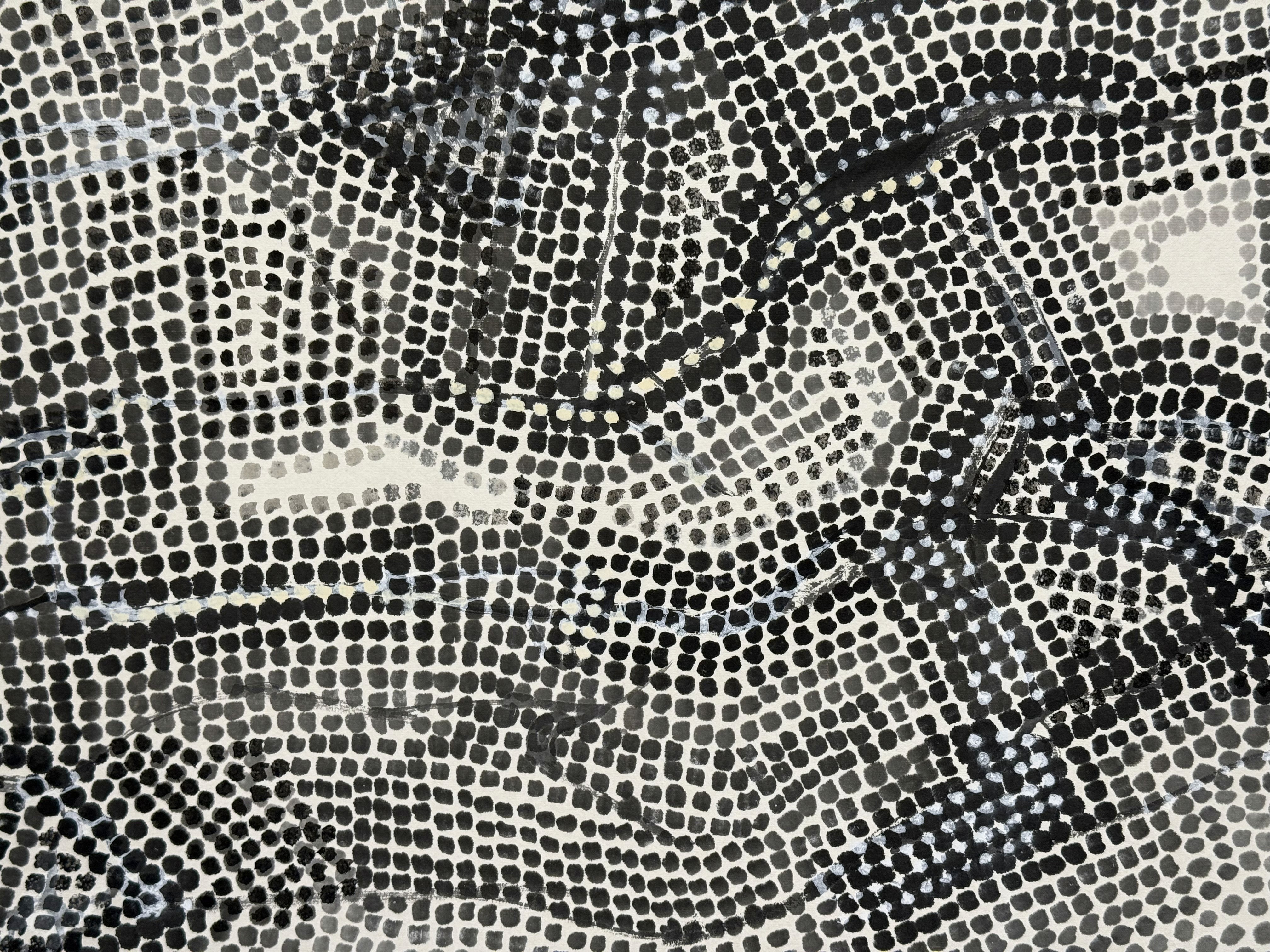
The contours in these works are especially compelling. They appear to demarcate forms, yet they dissipate under scrutiny, built from accumulations rather than lines. This raises a subtle but persistent question: when we perceive a shape in the visual field, what are we actually seeing? The contour itself, or the peripheral fragments that assemble into the illusion of contour? Wang’s paintings live in this perceptual ambiguity. They draw the eye toward structure only to reveal that structure as provisional—an emergent effect of sustained attention.
The subtle colour of the walls fits that of Wang's compositions
Courtesy of the Gallery
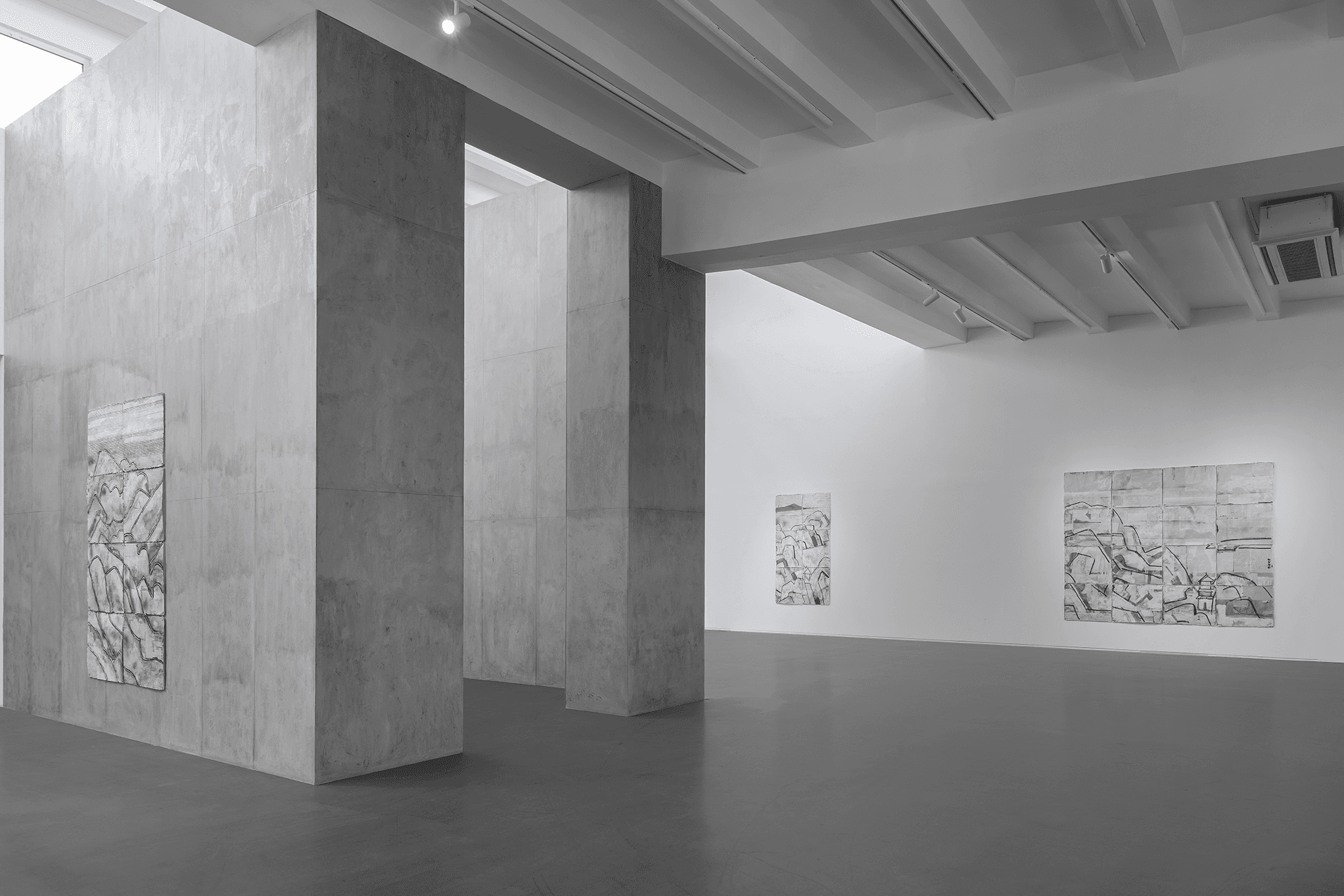
Hints of Chinese calligraphy reinforce this oscillation. Embedded within the stacked xuan paper are ghostly strokes—residues of rhythm rather than legible text. Ink, acrylic, and calligraphic gesture merge into a hybrid syntax that feels inevitable, as though the materials negotiated their own equilibrium.
Part of this fluid hybridity can be traced to Wang’s formative years. His education—stretching from Soviet-style academic training to the Shanghai Art School and later the University of Applied Arts in Vienna—placed him amid fundamentally different artistic systems. In Accretions, one can almost see him actively fighting these disparate techniques as he seeks harmony. The dense modeling inherited from European academism resists and gradually yields to the atmospheric looseness of ink. The planar logic of printmaking encounters the intuitive pulse of calligraphy. The reconciliation is not seamless; it is negotiated, even wrestled into being. Yet from this struggle emerges a uniquely coherent language—one that refuses binary categories and insists on coexistence.
Apart from Wang's larger compositions, there is also a series of smaller works available
Courtesy of the Gallery
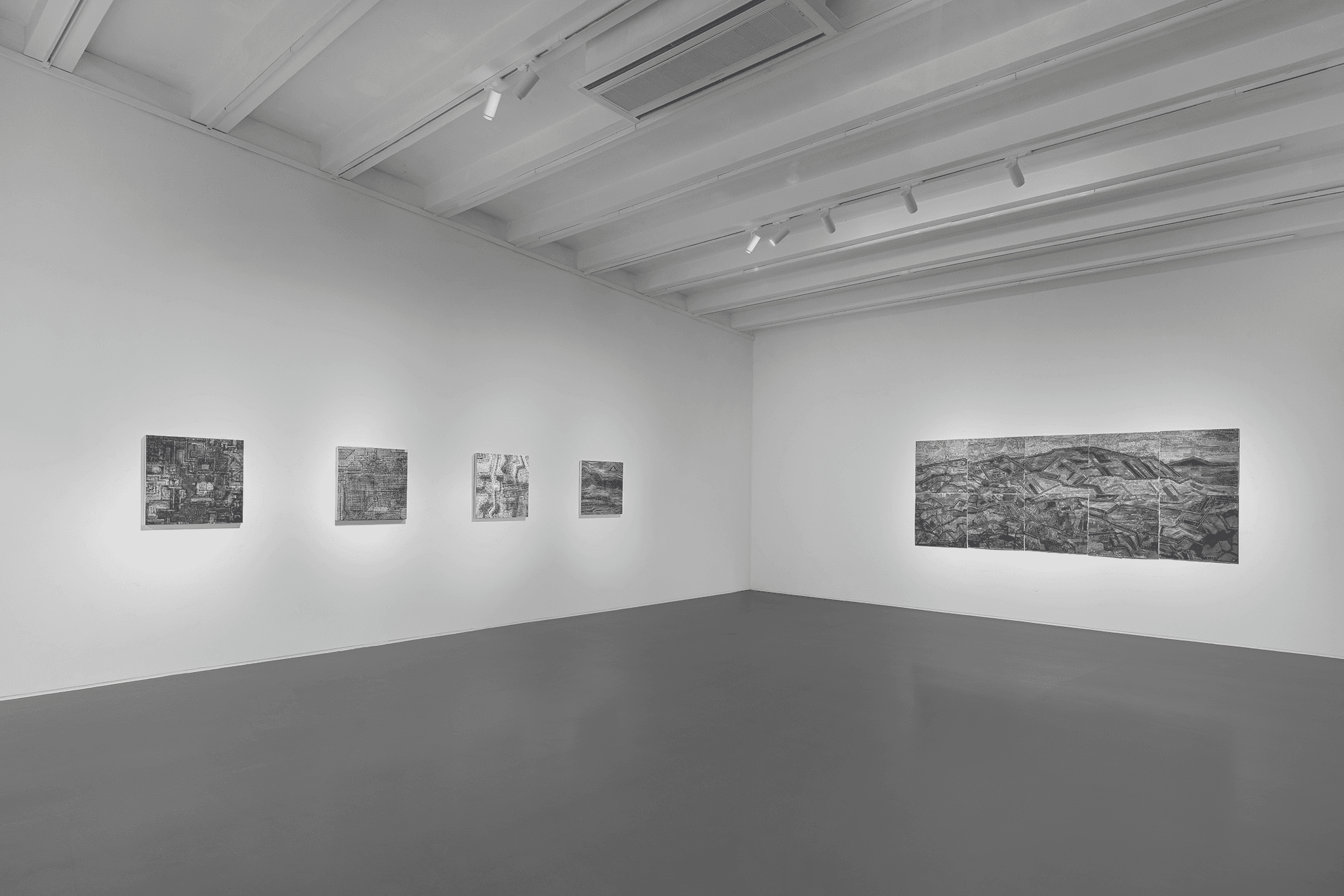
What ultimately defines the exhibition is the sheer precision of its surfaces. Every dot is minutely calibrated, yet no two are identical. Unlike the mechanical regularity of Lichtenstein’s Ben-Day system, Wang’s marks vary tirelessly in tone and absorption. The multilayered paper introduces micro-shifts that accumulate into an image that hovers between two and three dimensions—flat yet deep, abstract yet uncannily topographic.
Accretions becomes, in this sense, not a landscape but a proposition about seeing: that perception moves between micro and macro; that the world is always partly constructed by attention; and that meaning, like ink, emerges only through time, patience, and observation. Wang achieves this without spectacle. His art remains rooted in subtlety, restraint, and the slow unfolding of vision.
积楮--王劼音作品展
Accretions: The Art of Wang Jieyin
艺术家 / Artist: 王劼音 Wang Jieyin
学术主持 / Academic Moderator: 皮道坚 Pi Daojian
策展人 / Curator: 方志凌 Fang Zhiling
展期 / Duration: 2025.11.22 (Sat) – 2026.02.08 (Sun)
地点 / Venue: 亚洲艺术中心(北京)Asia Art Center (Beijing)
北京市朝阳区酒仙桥路2号大山子798艺术区(周一休馆)
Dashanzi 798 Art District, No.2, Jiuxianqiao Rd., Chaoyang District, Beijing
© 2025 by Hector Chen