Layers of Memory: Peter Doig’s House of Music
11/11/2025
Hector Chen
Serpentine South Gallery, London — until 8 February 2026
So many of Peter Doig’s influences come to mind even before a single painting appears. In a recent interview on A Brush With…, Doig spoke about revisiting Bonnard, thinking again about Caravaggio, and feeling “re-excited” by the colour freedom of Matisse and Derain in Collioure. Looking back at those Fauvist canvases reminded him how loosely colour can behave, how space can remain grounded without strict perspective, how a painting can stay alive by staying open. Walking into the Serpentine’s House of Music, it becomes clear that this openness isn’t theoretical. The exhibition surveys more than two decades of work, and in doing so reveals the full breadth of the influences that have shaped him—Trinidad, Europe, cinema, memory, and music.
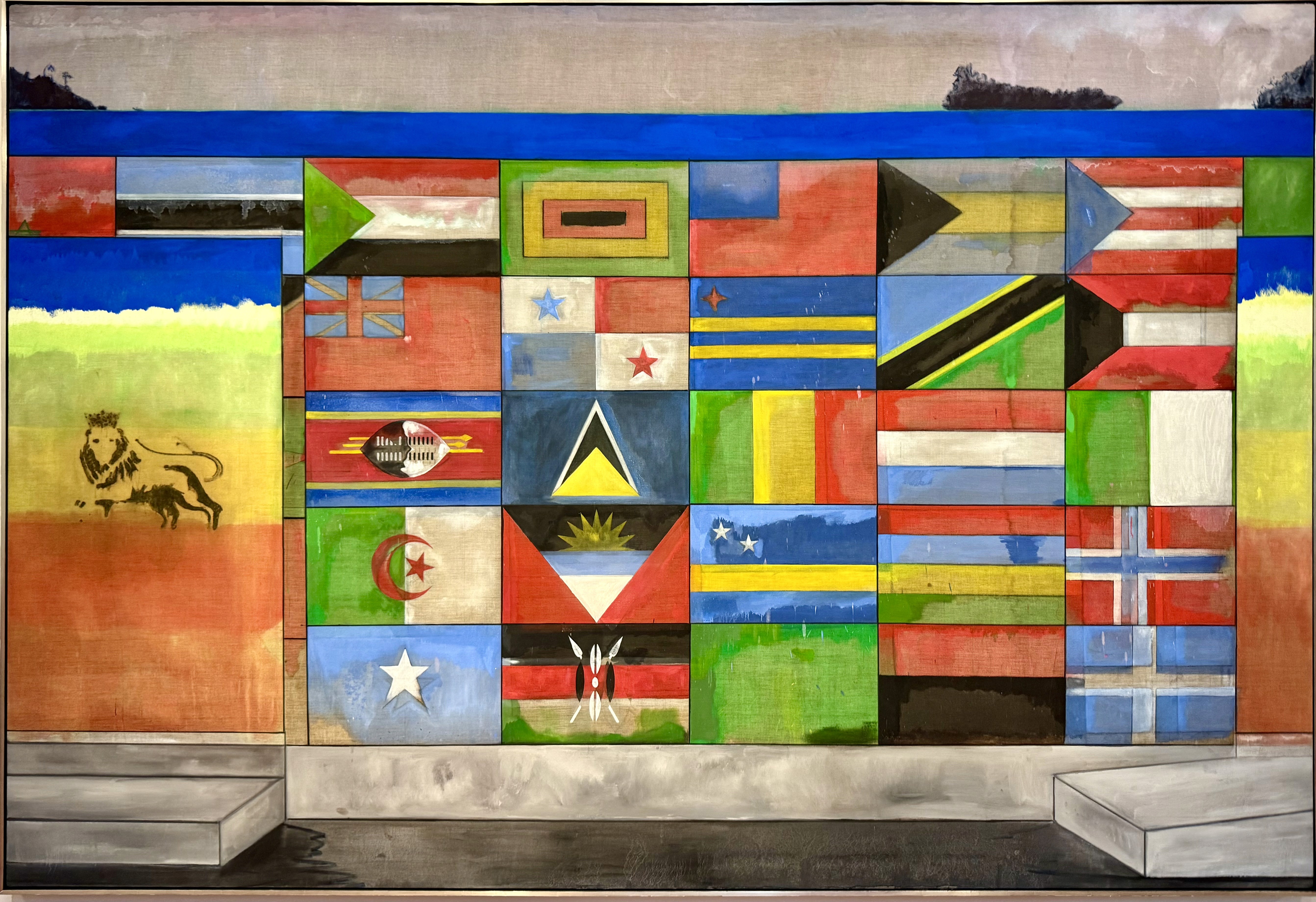
The opening rooms make these influences immediately clear. The first thing you encounter is Painting for Wall Painters (Prosperity P.O.S.), a wide, mural-like canvas based on the hand-painted façade of The Prosperity Club in Port of Spain. Its grid of incomplete flags—some faded, some missing stars, some improvised—feels like a map of the diaspora filtered through memory. It announces the exhibition’s core concerns: music, place and the lived textures of Trinidad. Nearby, Maracas (2002–08) and Speaker/Girl (2015) translate Trinidad’s towering beachside speaker stacks into black geometric monoliths that feel at once Caribbean and Constructivist. They read like memories retold until they become mythic—details softened, composition sharpened. Move further in and daylight takes over: the pale balcony scenes where figures appear and disappear like afterimages, hovering between presence and haze.
Peter Doig , Painting for Wall Painters (Prosperity PoS), 2010-2012
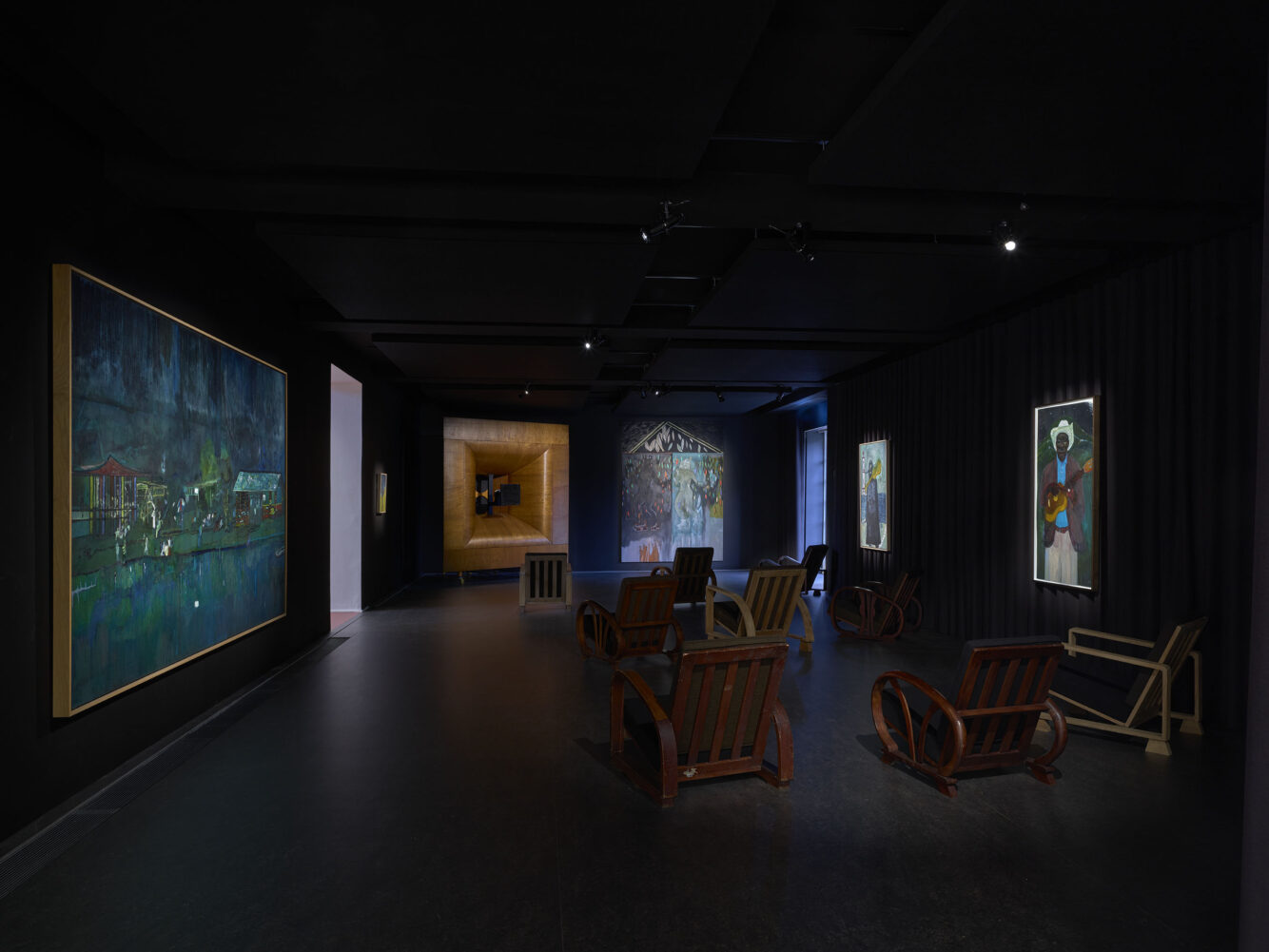
Then the light drops again into Music of the Future (2002–07), Doig’s remarkable nocturne stitched from Trinidadian experience and a postcard of Kerala. The atmosphere is held together by mood rather than geography. In person, the surface becomes even stranger. Layers of varnish and oil catch light unpredictably. Look with one eye and the image stabilises; open both and reflections shift, water shimmers into something uncanny, colours slide across the canvas. In the water—washed in purples and greens that seep into the linen—Helen Frankenthaler’s soak-stain influence rises quietly. The painting seems to breathe.
Peter Doig: House of Music, Serpentine South, 10 October 2025 – 8 February 2026. Photo: Prudence Cuming Associates
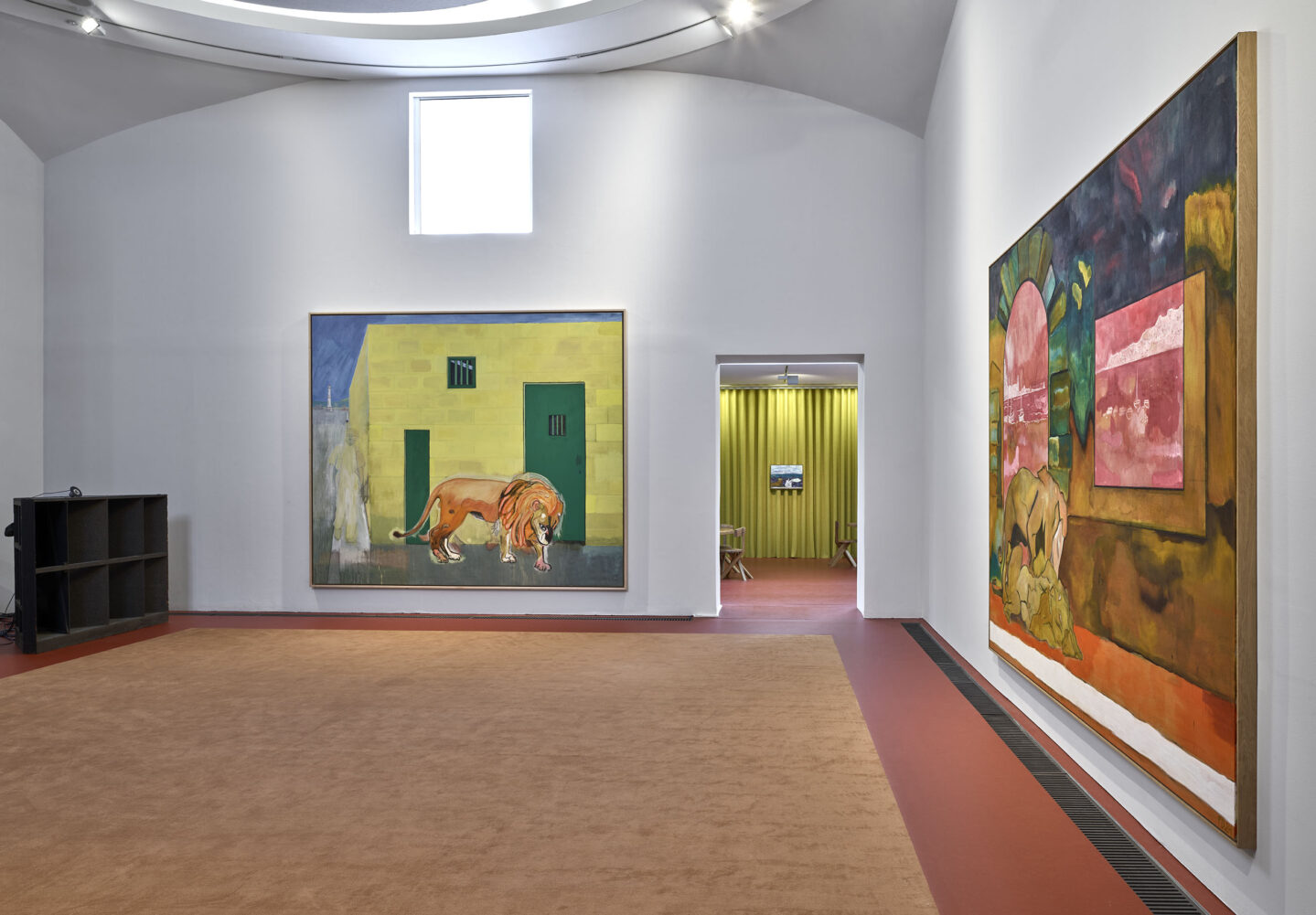
The emotional centre of the show is the domed North Gallery, where three monumental, life-size Lion of Judah paintings face one another. The lion first entered Doig’s work through Trinidadian graffiti and old zoo photographs, but he has since released it into landscapes where Caribbean iconography, European architecture, biblical symbolism and theatrical light coexist without explanation. In Rain in the Port of Spain (White Oak) (2015), a lion paces the bright yellow façade of a British-built prison. The painting becomes a meditation on authority, resilience and historical residue. Echoes of Niccolò da Tolentino’s world-making appear: the horizon controls depth; planes are stacked rather than plotted; space is implied rather than measured.
In Lions (Ghost) (2024), two golden animals wrestle while a shadowy human struggle—borrowed from Caravaggio’s Beheading of John the Baptist—flickers in the background. Behind them, the shoreline blushes Matisse-pink, recalling Collioure and reminding us how easily Doig folds art history into lived experience.
Peter Doig: House of Music, Serpentine South, 10 October 2025 – 8 February 2026. Photo: Prudence Cuming Associates
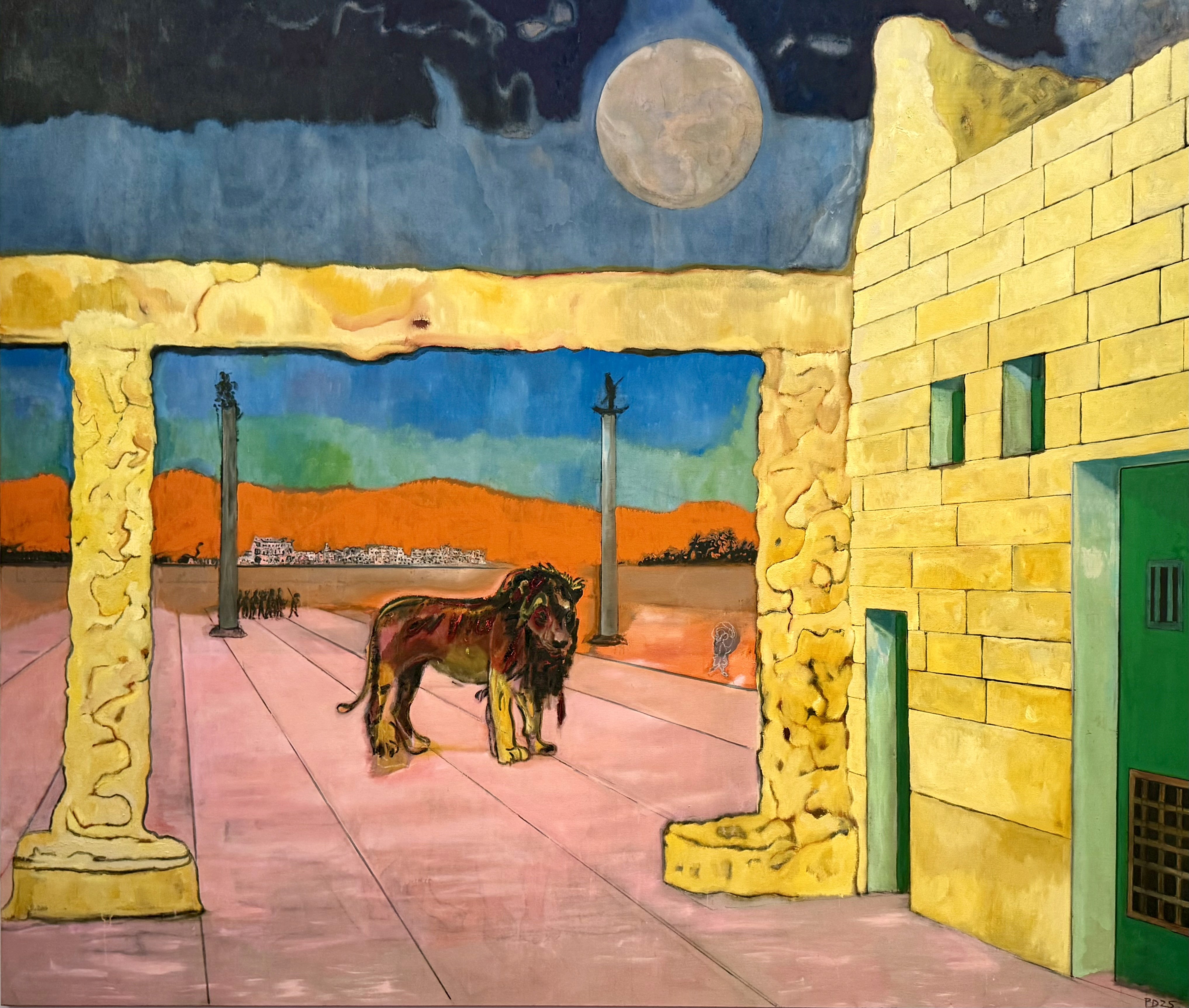
The newest lion painting is the most unsettling. A thinned, wounded lion stands alone in a pink piazza framed by collapsing columns and fragments of Venetian architecture, as if the city has been hollowed out. The sky shifts from grey to green to red. With the three lion paintings together, there is a faint Canaletto echo in the immersive effect—especially in the way Doig recalibrates the horizon across canvases—yet everything is warped through his own dream logic. The painting feels silent until you notice, almost hidden, a tiny marching band on the far edge of the square, still playing. Whether their music is fading into emptiness or defiantly carrying on is impossible to know. That suspended ambiguity—hope and dread in the same breath—is where Doig’s strongest paintings live.
After the intensity of the lions, the surrounding galleries offer a softer register. The small portrait Embah in Paris glows with quiet warmth, a memory of the Trinidadian poet-artist with whom Doig shared fourteen years of studio life. 2 Girls (2017) and Blue Nude (2015) feel almost like film stills—figures dropped into lush atmospheres that never fully resolve into narrative. Painting for Wall Painters (2010–12) returns to Trinidad’s hand-painted signage and street murals, capturing the faded vibrancy of a Port of Spain club façade. These works remind you that Doig’s world isn’t built from grand scenes alone; it is built from small, almost private encounters with colour, surface, music, and memory.
What gives the exhibition its particular charge is the soundtrack. Doig’s eerie paintings are set to music selected from his personal vinyl collection and played through immense Western Electric, Bell Labs and Klangfilm speakers salvaged from old cinemas by his collaborator Laurence Passera. These towering horns and wooden cabinets hum through the galleries like sculptural presences. The paintings do not illustrate the music; they share its emotional register. Longing, drift, suspension, sudden clarity. The rhythm of memory. All of this unfolds in a space that feels closer to a studio than a gallery. Music loops. Light shifts across surfaces. Paintings from different eras speak to one another quietly. The Serpentine becomes, for a moment, a room where memories are layered rather than displayed.
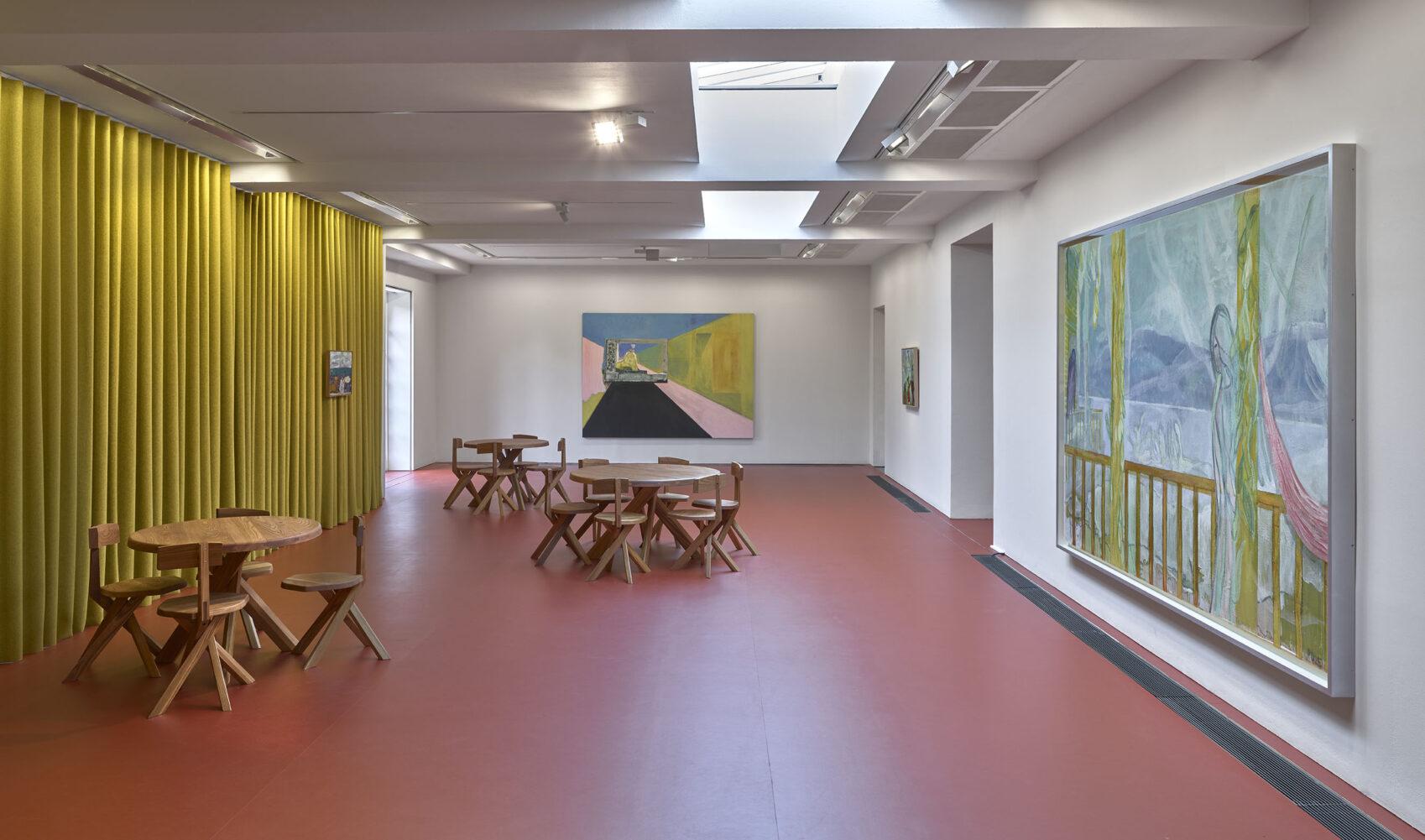
As I walked through the galleries, I kept seeing small groups of art students sketching—absorbing colour, figuring out space, tracing how atmosphere is built. Their presence brought me back to Doig’s words about teaching: he said the term “teaching” never felt right, because students are “artists too—just at a different stage.” He described painting as an exchange, a dialogue that moves in both directions. Watching those students gave me confidence that this influence—the kind carried through conversation, observation, and generosity—will continue far beyond the run of this exhibition.
House of Music succeeds because it preserves the internal logic of Doig’s studio: the sound, the slowness, the layered memory, the freedom to move between histories without declaring allegiance to any. It lets us inhabit his way of looking and listening. The result is a show that feels deeply personal, quietly ambitious and unmistakably alive.
© 2025 by Hector Chen